
All Posts By

Pandemic

Sybrand Veeger THE BODY AS A PRISON - November 2018 Tjan Ho Lai

Parallel Spinozas, the Craftsman and the Philosopher

Written by Sybrand Veeger

Baruch Spinoza: the name of the 17th-century, Dutch, daytime lens-grinder, and nighttime philosopher, of the excommunicated Amsterdam Jew, of a solitary yet dextrous lens-grinding body, of a joyful and infinitely thought-provoking mind. Baruch means the blessed, Spinoza, he who comes from a spiny place.

Baruch Spinoza: the blessed spirit from the spines.

Spinoza had one method for the making of telescopes and metaphysics – Euclidean geometry. One begins with a number of axioms, these are irreducible and self-evident truths about the world, to then deduce certain optical theorems, or philosophical propositions, that follow strictly from these truths, to determine the concavity, convexity, transparency, and opacity of what we can see, of what we can know.

What did he see? What did he know?

As preliminary work, he had to wipe off the foggy dualism left by the Cartesians, who thought that mind and matter were divinely connected through the work of an intervening God. The axioms then led the blessed telescope-maker to a different idea, to develop a clear and pristine metaphysical image.

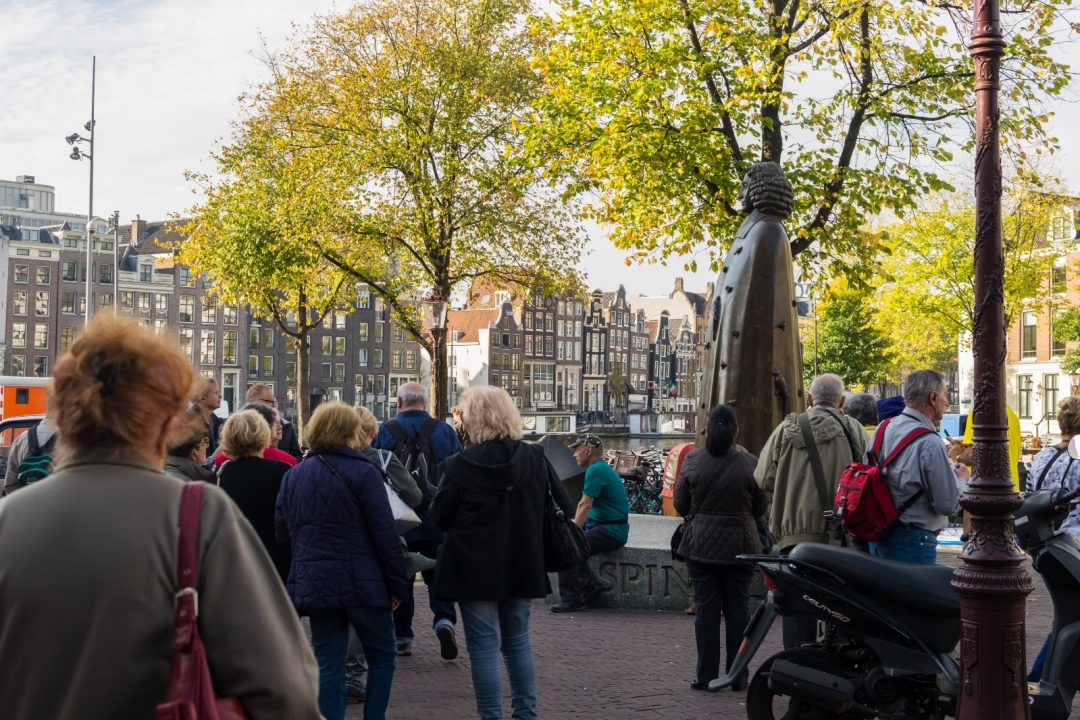
Excommunication curse of Spinoza by the Amsterdam Jewish Community. Photo: Tjan Ho Lai

Axiom 1: God is Nature

First, he observed that God must be equal to nature. God, or nature, is the one and only substance constituting the world, it is everything that is – there is by definition nothing outside of it because what would be outside of it wouldn’t be. The oneness of the world, the identity of God and nature, constitutes Spinoza’s first theorem: monism.

For Spinoza, the craftsman, this meant that Jupiter and the telescope with which he observed it worked according to the same fundamental laws. For Spinoza, the metaphysician, it meant that the truth about the world and the mind with which he conceived it were fundamentally identical.

Axiom 2: God-Nature has Infinite Forms

Second, he saw that because God-Nature is absolutely infinite, it follows that it has infinite forms of expression. Merely two of these forms, which Spinoza calls attributes of God-Nature, are conceivable to us – thought and matter. Attributes are how God-Nature expresses itself and they are infinite in their quality as attributes. It follows that there is an infinite amount of infinite attributes: the limitless expressionism of God.

Spinoza observed that due to the existence of one substance only, “[t]he order and connection of ideas is the same as the order and connection of things” (7, 2, Ethics). Geometrically, and optically, attributes form a parallelogram of lines that never touch each other but express in different forms the one substance, God-Nature. There is a correspondence between attributes, in the sense that attributes always express the same thing, but there is no real causal interaction connecting them. Mind and matter never really touch, they run parallel, never perpendicular.

Axiom 3: God-Nature has Infinite Production

Third, Spinoza observed the work of God-Nature, it’s infinite production. If attributes are the forms of expression, then modes are the content of expression, what is expressed. Modes can be infinite, like, say, energy; and modes can be finite. Modes can be simple, like the asteroid, or can be complex enough to be self-conscious, like the human.

Spinoza noticed that he was one mode of God-Nature, operating through two parallel attributes, Spinoza as the craftsman, and Spinoza as the philosopher. Spinoza’s lens-grinding body, expressed through the attribute of extension; Spinoza’s metaphysical mind expressed through the attribute of thought. One mode of God-Nature, one individual, constituted by a body and a mind: two parallel expressions of the same thing.

Photo by Adrien Olichon

What We Can Know

Body and mind, therefore, are modes forming a complex, self-conscious union, an emergent mode – the human individual. My body is the expression of my individuality in God-Nature’s attribute of matter, whereas my mind is the expression in God-Nature’s attribute of thought. My mind is the idea of my body, and my body is the object or ideatum of my mind. Mind and body are lines that never touch, yet the order and connection of the idea, my spirit, is always parallel to the order and connection of the ideatum, my body. There is a perfect correspondence between the mental and the physical, neither comes a priori, like two mirrors facing each other in parallel, reflecting themselves to infinity.

Spinoza, daytime lens-grinder and nocturnal philosopher, did not only deduce the parallel relation between mind and body, but also lived according to it, personified it. He made parallelism an expressionist ethic.

Browsing through Spinoza’s biography at the Jewish Historical Museum. Photo: Tjan Ho Lai

Contributor THE BODY AS A PRISON - November 2018

To Only Exist As A Mind

Written by Marten Bart Stork

Some say that the body is the temple of the holy spirit.

Others say it is a prison for the soul.


But however we may see it, we seem to be stuck with it. (At least for now)


Or is there somewhere else we can go?


What if we could leave our body before we die?


In the future we probably will be able to have a fully functional isolated brain.

Separate from our body.

(Free from physical pain?)


Or will consciousness be digitized?


Either way, it seems likely that we will at some point be able to leave our bodies behind.

(While we are still alive)

And exist only as a mind.


Try to imagine what that would be like.


To exist only as a mind.


Will it be like a dream?

An everlasting dream?


For time would no longer matter when we could (potentially) live forever.


Will technology enable us to transcend to beings of pure consciousness?


Could we create a complete universe inside our mind?

A perfect non-physical (virtual) reality for every one of us.


A place where we can do and create anything we can imagine?


Maybe god did not create the universe, but the universe is creating gods.


Gods that in their turn create new universes.


That in their turn create new gods.


Infinite realities.

Infinite possibilities.

THE BODY AS A PRISON - November 2018

Introduction: The Body As A Prison

Dear Infected,

The body is a delicately balanced composition of limbs, organs, fluids, textures. It is a collectively working series of systems, forming an organism with reflexes, motor skills, gut feelings, and muscle memories. The body, both the lens through which we experience the world and the physical material that makes us part of it, continually adapts and evolves within our lifespans – and the larger span of time.

And yet, despite only knowing life through our bodies, at times we begin to feel trapped, dissatisfied, or uncomfortable. With the chemical balances of our bodies. With the limited timeframe of being singular entities. With the dissonance between the way we feel and the way we are seen.

The body can begin to feel like something from which we wish to escape.

This month we hope to explore these dissonances: What lies behind the feeling that our bodies are miss-fit? How have people around the world, and throughout history, dealt with this notion? Where do we search for symbiosis? Who has inspired us out of this clash? Why does the clash even exist?

This month, our staff writers are channeling their own experiences, memories, and knowledge towards the topic, The Body As A Prison, hoping to unpack it, one creation at a time.

If you have any perspectives to share, hunches to work out, or images to show, we welcome you to make a contribution.

All our best,

The Pandemic Team

 
Art FILTERED RECOLLECTIONS - October 2018 Lennart Roos Valentina Gianera

LONELY MEMORIES

Video by Valentina Gianera & Lennart Roos

The theme of this month’s issue can be approached from various angles. When crafting the idea for the movie, we chose for a very personal approach. We wanted to indulge in people’s memories, let ourselves be carried to distant moments and places. Moments and places only they themselves know about, because buddy, they’re alone.

Strangers asking people to share a moment of solitude is a strange thing.

You want them to feel comfortable. Not have them worry about their expression. Be able to get wound up in their memories without having to decide whether to look at the camera or into themselves. But you still want to catch a glimpse of their personality. And as Stefan Zweig noted in 24 Hours in the Life of a Woman (1927), there is no better way to do so than observing people’s hands perform.

Art Dee Hehewerth FILTERED RECOLLECTIONS - October 2018

Renee Turner: The Warp and Weft of Memory

Interview with Renee Turner

Dieuwertje Hehewerth: Dear Renee,

Perhaps it’s good to start by admitting that it was the title that drew me to the exhibition. Spending an off-afternoon updating myself on Amsterdam’s exhibitions, I read the words “The Warp and Weft of Memory” in the Amsterdam Art Calendar. My mind was imbued with thoughts about Filtered Recollections – due to Pandemic’s October theme – and so the title synced with my current preoccupations, leading my feet to Castrum Peregrini. I had no idea what the exhibition would be. But I had once spent a rainy afternoon there attending a talk, and the space was amazing – so what was there to lose?

My experience of Castrum Peregrini is colored by a person named Gisèle. A person who, from the moment of stepping through the door, becomes a household name: one I am embarrassed by not knowing about; one I slyly ask questions about until an approximate profile is commandeered. She was an artist, a traveler, and now patron of the arts, whose house, after her passing, has been dedicated to researching and encountering art.

A quick scan of the website tells me this is only part of the place’s story. But Gisèle’s story is the one that is currently on show: on the lips of the gallery attendant, on the cover of the recently written book, and on the floor of her studio where you have exhibited your research – a research that has been conducted through her left-behind clothes.

Printed publication, “The Warp and Weft of Memory” designed by Cristina Cochior, 2018

My visit led us into conversation, leading me to ask if I could continue this conversation, in the form of an interview, in relation to the topic that had brought me there: Filtered Recollections. So here we are.

Since visiting the exhibition, I’ve been looking at the online component of your project – reading the letters between yourself and Kate, between yourself and Frans-Willem; looking at your documentation of Gisèle’s clothes. I realize the research is about remembering a person you’ve never met, and I wonder how it has been for you to engage in this conversation? One where you ask questions but are never questioned back?

Renee Turner: I suppose in one way or another, history is that kind of encounter or dialogue – we speak to those people, things or events that cannot talk back. Fragments left behind are inevitably space for projection where the present and past are woven together.

DH: The more I engage with the project, the more it feels to be planted in – and growing from – Gisèle’s wardrobe, rather than being about it. Which leads me to ask, what is your relation with Gisèle now that the project is concluding? Is the project still about her memory, or has it grown in other directions?

screenshot detail, “Notes”, Development and Interface by Manufactura Independente, image © Stichting Castrum Peregrini

RT: One of the thoughts that was consoling to me was that while I was working on this project, Gisèle’s biography was being written by Annet Mooij. She covered that territory. As an artist, I’m not sure that’s where my area of expertise or interest is situated. From the beginning, I wanted to focus on the encounter with her wardrobe and the strangeness of going through her closet while not being a relative. We’ve all had the experience of going through a deceased loved one’s belongings and deciding what should be thrown out and what should be given to other family members or friends. But this was not the case – nonetheless, I was a woman going through another deceased woman’s closet. Her things reveal something about her as an individual, but also tell stories that many women would recognize.

DH: I find it really interesting how your research leaves the confines of Gisèle’s wardrobe in the form of letters – or emails posing as letters – as noted by Frans-Willem. This letter writing allows the research to expand – beyond yourself, beyond Gisèle – through musing on topics beyond her clothes. Is the letter as a form important to your research? Has this decision shaped it into a particular form?

screenshot detail, “Epistolary” with Kate Pullinger, image © Stichting Castrum Peregrini

RT: The choice for epistolary as a form arose for different reasons. Barring one letter, I chose not to read Gisèle’s correspondences. And she had loads of them – she not only kept the ones written to her, but also when her parents died, and later her husband, she inherited back the letters she had sent to them too. (To live longer means letters are returned to sender.) I knew if I immersed myself in her letters I would occupy both her “I” and “eye”. I wanted to write from my perspective – that’s why one section is called “notes”. To me, it was like taking field notes from her closet – I was journeying into her private space.

But sometimes this felt too diary-like and hermetic. The correspondence with Kate Pullinger, who is a fiction writer, and Frans-Willem Korsten, who is Professor of Literature, opened things up again. These letters, or electronic mails (AKA emails), were sent while on my voyage into Gisèle’s closet, and like any correspondence written while journeying, they tell something about travels past and present, daily banalities and also something about the sender and the recipient.

screenshot of Semantic Mediawiki designed and developed by Andre Castro and Cristina Cochior, which feeds into the interface of http://www.warpweftmemory.net, image © Stichting Castrum Peregrini

Next to writing with Frans-Willem and Kate Pullinger, another way I broke out of my own insular thinking was having others involved who shaped and informed the narration. The backend of the site, which is a Semantic Mediawiki, was worked on extensively, and designed, by Andre Castro and Cristina Cochior. The database, containing around a thousand items, is much like Gisèle’s archiving: it has its own idiosyncratic logic. The frontend interface and development was designed by Manufactura Independente, who made the different registers legible. I also worked with Cesare Davolio who did the illustrations for the notes. He created an almost dream-like space through his drawings.

screenshot detail of an illustration by Cesare Davolio for “Semantics Matter”

DH: This letter-writing, paired with the focus on clothes, makes the research focus on, and work through, ephemeral forms. They are objects that have a transitory quality – a quality of carrying and covering – of existing as an in between. I’m curious if you see these relations? And more directly in relation to the project, what it is about these ephemeral objects/forms that catch your attention? What have you learned by exploring these mediums as a way to remember and engage?

RT: It is precisely the ephemerality that fascinates me. Like the body, Gisèle’s clothes will turn to dust, photographs taken to preserve memories will fade, or lose relevance, simply because those represented are no longer remembered. But there are always echoes. I thought often of Virginia Woolf’s line in To the Lighthouse where she says: “how once hands were busy with hooks and buttons; how once the looking-glass had held a face; had held a world hollowed out in which a figure turned.” I think by going into the intimate space of her closet, I imagined her figure. And I say imagined, because there is always an element of fiction in remembering, especially with things you have never known.

screenshot detail, “Semantic Tapestry”, Development and Interface by Manufactura Independente, image © Stichting Castrum Peregrini

DH: For me, the interesting thing about the exhibition has been how it dives into history, only be projected back into the present/future. But I’m curious what is it about the research that you really enjoy? Is there some unexpected part of the process that you learned greatly from, but is so obscure – or seemingly insignificant – that nobody thinks to ask?

RT: I think there are almost too many surprises I encountered to focus on one. Perhaps a list:

*Gisèle was a complex figure – her history is plural and contradictory – in 100 years one can live many lives, and it is a life that will be re-written by many. Lives are full of sediment to be excavated by future archeologists.

*She wore corseted dresses as a young woman, tattered and worn clothes during the war, went braless on the beach while wearing a kaftan in the seventies, and she wrapped herself in a warm woolen sweater in her twilight years.

*Her closet is representative of many women, but her cataloging is unique, obsessive if not pathological. I wondered if she suffered from some form of hypergraphia. She has closet inventories going back for decades.

Detail of Gisèle’s wardrobe inventories, “Semantic Tapestry”, image © Stichting Castrum Peregrini

*One of the challenges of representing textile digitally is how to show its tactility. The revelation for me was the simple act of folding the clothes on video. You hear the sound and the weight of the cloth. This is how touch came into the project. Go to the Semantic Tapestry and look under Theme: Folding.

Screenshot “Semantic Tapestry”, Theme: Folding, Development and Interfacffe by Manufactura Independente


*When I look in Gisèle’s mirror, I expect to see her posing in front of it as she so often did before, but instead I only see myself.

Gisèle’s mirror, 2018