
Browsing Category

Creative Pieces

Creative Pieces FILTERED RECOLLECTIONS - October 2018 Jonas Guigonnat

I Remember, Thus I Create

Written By Jonas Guigonnat

The ability of the human mind to be triggered by remembered sensations never stops astonishing me. Memory is often seen as a question of remembering “images” and “thoughts,” but all of our senses are playing a role. Most of the time it is a strong, subconscious activation.

Take the creative process as an example and you’ll realize how much past experiences are often the driver behind your capacity to create. Each sense plays a part, from what you heard, or tasted, to what you saw, or even touched.

Never underestimate the power of your memory. Even great temporal distance doesn’t seem to restrict the influence of the experiences and feelings we remember.

Twenty years ago I discovered graffiti and practiced it earnestly for about 5 years, but from that point onwards the feelings and sensations related to it never left my mind. As every graffiti artist, or “writer”, experiences it, my obsession for graffiti is never very far away, even when it feels like a lifetime ago.


Shapes of the streets

Everything began with what was to be seen: letters, letters, and again letters. They quickly became a source of obsession and modified the way I saw the creative process behind calligraphy. The style calligraffiti fascinated me at once, to the point I was dreaming of it.

I worked for hours trying to create shapes which transmitted the same energy, the same vibration as the pieces I saw on the streets. The feeling of being able to create my “own” letters motivated me to always do better. From that point onwards, every type of letter I saw could slip into my brain and find its way to the next piece of paper, and finally to the next wall.

Nowadays, even though I don’t practice actively, I still look for the perfect letters almost subconsciously. Any piece on the subway, on the street, or on the highway makes me want to take the cans and spray my letters out again.
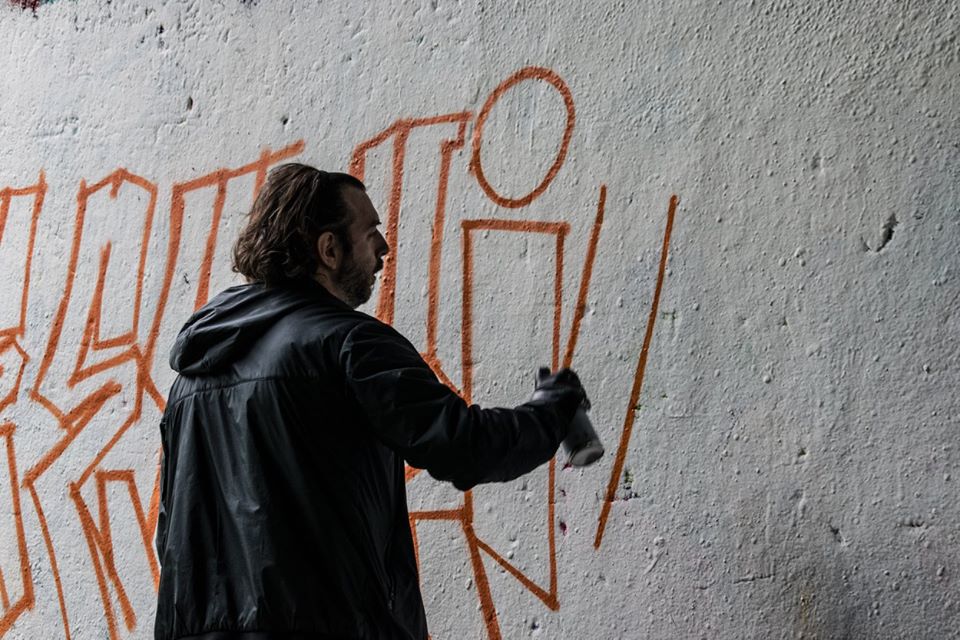
 

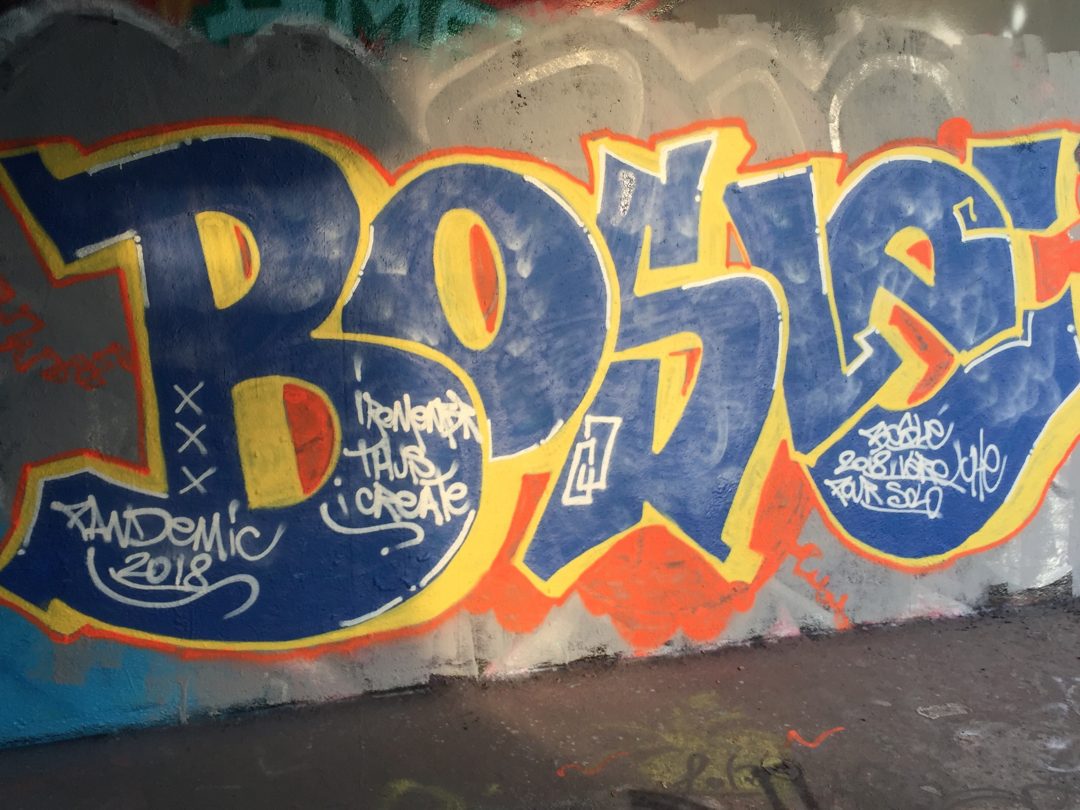
One of my pieces from April this year at a legal spot in Amsterdam. Photo: Jonas Guigonnat

Sounds of the past

My vision is thus playing a crucial part in this process, but my ears have also their part to play.

The noise of spraying cans still hooks me, the sound of pens scratching paper has never stopped haunting me, and the cacophony of Paris by night calls for me to paint its walls.

The sounds of every season bring me back to a place and time where I was writing something on the streets. Rain on scraps of steel, a subway taking its last ride, the silence of a sunny day or birds singing early in the morning – all of it triggers my will to create, even before my consciousness itself is aware of it.


Tell me what you smell, I’ll tell you what to create

Then there is also a multitude of triggering smells. Particularly the one of ink and of paint from a spray can, which awaken my obsession with the same force.

The same way noises play with my perception of the present, smells can also, out of nowhere, bring me back to a street in Paris in the early 2000s. The smell of wet leaves on a dark November day, of hot asphalt in the summer, or of a dry cold winter. All refer to moments of inspiration or of despair, either way pushing my creativity.

Touch and smell also have an influence, but it is a lot more subtle and difficult to grasp when it comes to the visual arts. Nonetheless, some feelings, like the one of grabbing a can, also push my mind to look for inspiration in the past.


One of my pieces from April this year at a legal spot in Amsterdam. Photo: Jonas Guigonnat

Holy adrenaline

When it comes to graffiti, if there is one bodily feeling above all others that I would choose, it is the adrenaline flowing through my body. Every writer experiences it as an addiction and as an important factor in this specific kind of creativity.

Taking risks is necessary if you want to exist in this environment. Otherwise, you would not be able to understand the essence of writing and will instead practice it like any other visual art.

But what makes graffiti unique in the eyes of thousands for almost 50 years (the discipline as such is said to exist since 1969) is mostly the fact that vandalism cannot be separated from the artistic process itself, once again, giving a feeling never to be forgotten.

 

One of my pieces from April this year at a legal spot in Amsterdam. Photo: Jonas Guigonnat

Creative network

The complex network of feelings recorded by my mind allows me to be creative in a very particular way. Not even my own will has as much influence on my capacity to express myself through art.

Without remembering what it feels like to create, there would be no creating, or at least not consistently. It also means that every time there is creation involved, the connections between the remembered sensations allows it to take form, to become real.

We exist through our memory as much as we create through it.
Art FILTERED RECOLLECTIONS - October 2018 Tuisku "Snow" Curtis-Kolu

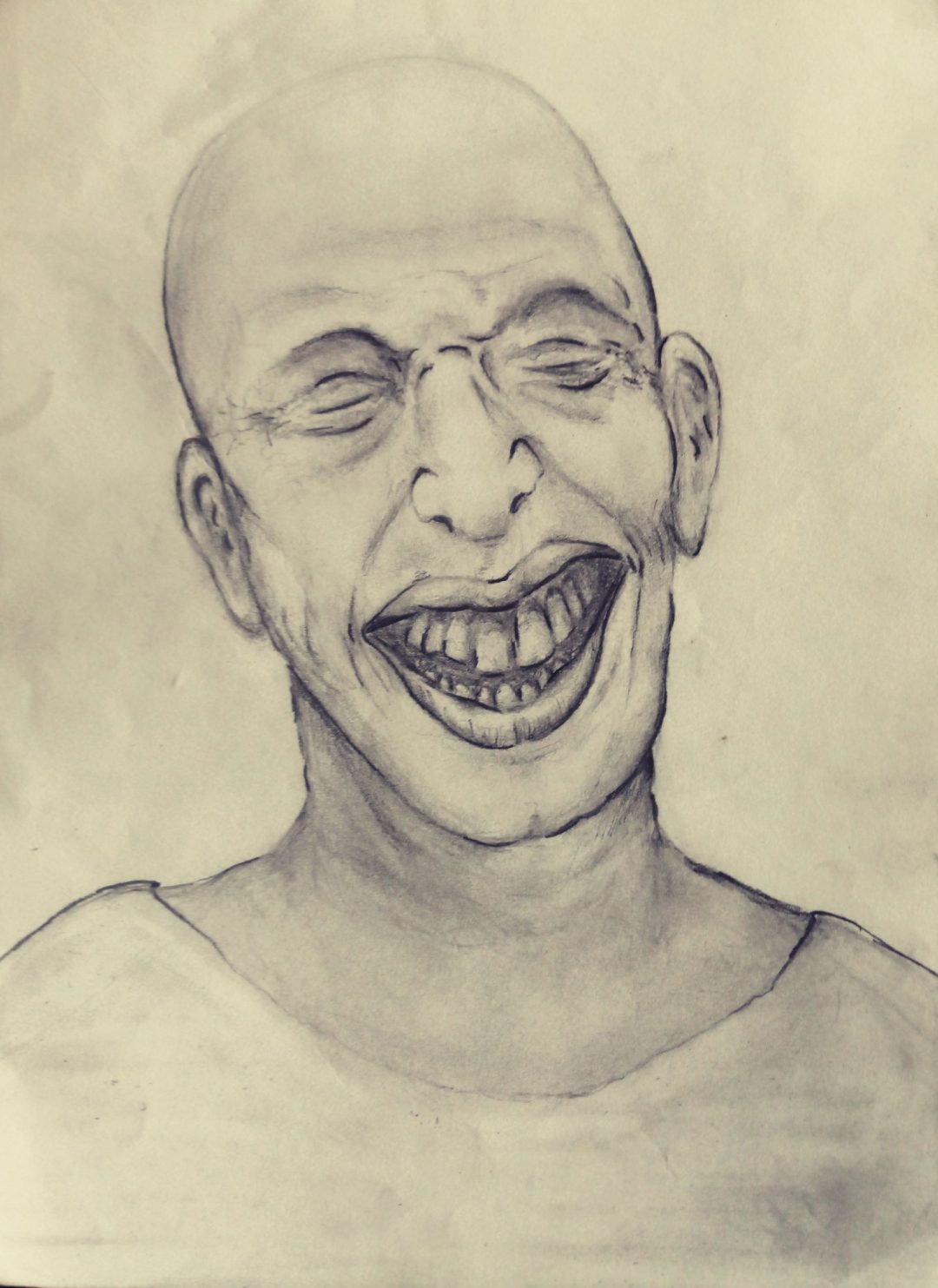
A Portrait From Memory

Art by Tuisku “Snow” Kolu

Sketching portraits can sometimes feel like an intimate act. You become familiar with the curves, wrinkles, and freckles on the face of a stranger, a passerby. For a moment, you know their face better than your own. You see the story of their life, their memories etched into their skin – from laugh lines around their eyes to the years of stress carved into their forehead.

To them, they’ve simply passed an oddly ogling stranger. To you, a face with a fascinating story immediately begins to be warped by your memory.

Get sketching materials before it fades. Before your attempted replica becomes a false representation of what gave you such a heavy feeling of life.

Art Contributing Writers FOOD POLITICS - September 2018 Tuisku "Snow" Curtis-Kolu

The Real Cost of Industrial Agriculture

The Hungry Ghost

Written by Elizabeth Knight

It has been found that industrial agriculture produces only 30% of our food while using 70% of our resources. While on the other hand, small-scale farmers produce 70% of our food while using only 25% of our resources. This article will show that not only is the dominant method of food production pushed by our culture not efficient, but it actually has many hidden costs.

The Cost of Emissions

While conversations grow around greenhouse gas emissions and the damage that fossil fuels do to our environment, there are still some major players that aren’t being discussed enough. Namely, Industrial Agriculture. In a report done by GRAIN, an international non-profit that supports small farmers, around 44-55 % of greenhouse gas emissions can be attributed to industrial agriculture.

Emissions come from several steps in food production. From the fertilizers and pesticides used to control crops. From machinery used to farm the land. From the cost of processing and packaging to transport and cooling of products. From the waste of products due to poor food waste management policies, both by governments as well as by grocery stores, restaurants, and consumers.

Then, of course, there is the growing awareness of how many greenhouse gas emissions come from the meat industry. Not only from the farms themselves but also from the destruction of forests and swampland either to house the CAFOs (concentrated animal feeding operations), or to grow monocultures, like corn and soy, that are used to feed them.  

All of this adds up to quite a lot of fossil fuel use, most of which is not actually necessary, and some of which is detrimental, not only to the environment, but also to society.

How Industrial Agriculture Contributes to the Climate Crisis by Klimakollektivet


The Costs of Synthetic Fertilizer

The system of Industrial food production is based on specialization, or the establishment of monocultures. Monocultures are when huge areas of land are used to grow only one product, such as corn, wheat, or soy. This system is established because it is easier. A grower uses large farm equipment to plant one type of crop. Then this one crop is fertilized with synthetic, or chemical, fertilizers and maintained with the use of pesticides. While this may serve a short-term goal of producing said crop easier, there are several problems with an industrial approach to the natural ecosystem.

One of the first problems is the cost of fertilizing these types of manufactured ecosystems. The production of synthetic fertilizers relies heavily on the use of fossil fuels, as an ingredient of the fertilizer and as a resource needed to produce the fertilizer. The production of nitrogen fertilizers, for instance, accounts for 3-4% of the global use of fossil fuels. When NO2 fertilizers are put out they immediately release greenhouse gases, as it’s not possible for the soil to absorb all of it at once. This layer of nitrogen fertilizers also prevents the soil from absorbing any other GHGs.

Another side effect of synthetic fertilizer use is the run-off effect. The fertilizer that the soil can’t absorb, which is much of it, runs into nearby waterways. These fertilizers then keep on fertilizing, and in so doing create an imbalance in the growth of algae and seaweeds. This unnatural growth leads to a chain of events which cause oxygen deprivation in the water, killing off any animals who need oxygen to survive. These are appropriately called Dead Zones, and are entirely man-made phenomena.

The industrial agricultural process involves the use of pesticides. Unfortunately, these pesticides don’t only kill the insects which would harm the crops, they kill everything. Every small insect and animal that lives in that area – from the birds, bees, and worms – dies, creating a lifeless environment. This lack of biodiversity means that the soil doesn’t have a good mix of nutrients in it.

This lack of nutrients creates an addiction to, you guessed it, synthetic fertilizers, which contributes to creating the problem in the first place. Like with all addictions, the saddest part is that a tolerance is developed, so more and more fertilizers are required to get the same results. A huge cornfield essentially creates a huge patch of land that is functioning in a way that is entirely alien to how life on earth functions. In other words, this is not a naturally occurring system, and cannot be sustained in the long run.

The Costs of Monocultures

The next step in the fossil fuel heavy journey of food comes with the global dependency on import-export culture. If each region is growing one or two things, which must be shipped around the world to other regions which are growing a different one or two things, a dangerous system is created where no region has food sovereignty.  This is dangerous for a multitude of reasons.

First of all, it means that if something should happen to a particular crop, those growers are completely devastated. We all know the proverb about putting all your eggs in one basket, and that’s essentially what industrial agriculture is pushing. We’ve seen examples of how dangerous this can be in several instances since the onset of monoculture. From, the tragic Potato Famine in Ireland, to the citrus blights which occurred all over the Eastern Americas in the 1980’s. When growers rely on one crop they make themselves considerably more vulnerable.

Secondly, this means that in order for any one region to support itself it is dependent on imports from other regions. The cost of this creates food that is absolutely soaked in fossil fuels. From the cost of processing foods to make them last longer to the cost of packaging and refrigerating them for long journeys, it certainly adds up.  

Another cost is the loss of biodiversity in ways which also affect culture. When small growers must compete with huge operations it makes it much more difficult. This means that every year, around the world, small family farmers are kicked off of their land and displaced. Often these farmers must move to more metropolitan areas and then become purely consumers instead of producers of food. Farmer Displacement can also lead to the splitting up of families, a loss of sense of place or self and cultural identity.  

In the past decades, the world has gone from eating a varied diet, which changed according to region and season, to eating a much more narrow range of plants and animals. In every species of plant or animal that we eat we have reduced the varieties considerable. This means that all sorts of culture and heritage have been lost to monoculture farming. In so doing we have lost our autonomy. When we no longer know where our food really comes from and we cannot decide what we want to eat, we suffer. Both culturally and nutritionally. This year there have been studies citing the loss of nutritional value for crops grown in monoculture and using synthetic fertilizers. Below is a small example of how many species we’ve lost in only 100 years.

The Final Bill

There are plenty of arguments from industrial agriculture lobbyists stating that this method of production is necessary for feeding the world, for feeding our growing population. However, this method of production is short-sighted and unsustainable. It boasts higher yields at lower costs, and yet it still leaves one in eight to go hungry.

The current system of food production doesn’t include in its true costs: high greenhouse gas emissions, loss of soil health, loss of healthy ecosystems, addiction to resource intensive fertilizers and pesticides, loss of biodiversity and loss of food sovereignty.  

In conclusion, it’s time for us to genuinely consider the cost of how we eat. We should demand that our policymakers make policy that is based on science and not funded by multinational corporations that concern themselves more with profits than with consequences. We cannot continue to bend the earth to our industrial ideals. It’s not sustainable and we see more and more research to support this. The Industrial Agricultural system is a relatively new system, and it’s best for us to stop this system before we completely lose the resources to do so. There are viable answers to feeding the world to be found in all sorts of food sovereignty movements, from organizations like Grain to Via Campesina to The African Center for Biosafety. Let’s all educate ourselves about industrial agriculture and the real costs of what we eat so that we can make informed decisions and protect the world we share.  

Art MADNESS - July & August 2018 Tuisku "Snow" Curtis-Kolu

Cycling Creativity

Written by Tuisku “Snow” Kolu

Creativity can be a kind of madness, taking over your motive and drive whenever or wherever it pleases. This can be problematic when you’re on the road and have limited supplies to express yourself. But the Creative needs to be fed. Limited supplies doesn’t necessarily spell disaster for the Creative, but rather reforms its drive to find a way to express itself. Hence you find yourself painting with a messy brush that is falling apart onto a piece of bark ripped from a tree. For now, your mind can be still from the need to create, but not for long.