All Posts By

Pandemic

FILTERED RECOLLECTIONS - October 2018 Max Muller

In Memoriam Ourselves

Written by Max Muller

You may think our disposition towards having a good reputation and being remembered fondly is the foundation upon which we base our actions. In this article, however, I will argue that this is not necessarily the case. I aim to show that it is not so much the idea of being remembered well that guides us through life, but that we are in actuality more concerned with being remembered. Period.

This can be inferred, in my opinion, by examining the lives and opinions of various historical figures and certain current cultural phenomena. I will try to unravel why being etched into our collective memory is so important to people.

A Lasting Legacy

First, let’s focus on the idea that everyone aims to leave behind a positive legacy. It can be illustrated well with the story of Alfred Nobel. As a precocious chemist and engineer, he invented dynamite in 1867. He patented his invention and made a fortune out of it.

When Alfred was 55 years old, his brother Ludvig Nobel passed away. Due to a misunderstanding, some writers for a French newspaper came to believe it was Alfred Nobel himself who had deceased. Thus they wrote an obituary of him, entitled “The Merchant of Death is Dead.” When he read it, he was appalled by the idea that he would be remembered as an opportunistic salesman of deadly weapons.

After he recovered from the shock of this discovery, he devised a plan to change his reputation. Alfred decided he would donate the majority of his wealth to the Nobel Prize (including, ironically, the peace prize). His legacy is nowadays largely viewed in positive light because of this generous decision.

A Higher Calling

Alfred Nobel was not alone in his aim to leave a positive legacy. Whole religions (with billions of followers) are centered around the idea of behaving well and reaping the benefits after death. In Christianity, for instance, sinners may redeem themselves to be allowed to go to heaven. Likewise, Hindus try to obtain good karma during their current lives in order to reincarnate as a better person in their next lives.

Thus, many people indeed wish to be remembered well, and will try to behave accordingly. They cherish the wish to have had a positive impact on the world. However, not everyone shares this kind of moral compass. Some are driven by other motives.

A Poète Maudit from Leeuwarden

Jan Jacob Slauerhoff (1898 — 1936) was arguably one of the most important Dutch poets of the 20th century. In addition to his literary qualities, he was also a notoriously difficult person. Tragedies and quarrels marked his life. Additionally, he was a womanizer of both married and unmarried women, and was chronically sick.

Towards the end of his life, he wrote his famous poem “In Memoriam Mijzelf” (“in Memoriam Myself”). The last two stanzas are worth quoting at length.

IN MEMORIAM MIJZELF

Ik laat geen gaven na,

Verniel wat ik volbracht;

Ik vraag om geen gena,

Vloek voor- en nageslacht;

Zij liggen waar ik sta,

Lachend den dood verwacht.

Ik deins niet voor de grens,

Nam afscheid van geen mensch,

Toch heb ik nog een wensch,

Dat men mij na zal geven:

‘Het goede deed hij slecht,

Beleed het kwaad oprecht,

Hij stierf in het gevecht,

Hij leidde recht en slecht

Een onverdraagzaam leven.’
IN MEMORIAM MYSELF

I leave no last bequest,

Smash life’s work at a stroke;

No mercy I request,

Curse past and future folk;

Stand tall where they now rest,

And treat death as a joke.

I look fate in the eye,

Have said not one goodbye,

But want men when I die

To say just this of me:

‘He did good very ill,

Served bad with honest will,

Succumbed while battling still,

Undaunted, lived his fill,

Intolerant and free.’

Slauerhoff had come to the realization that he would probably be remembered as an insufferable person after death. What is interesting in this regard is that he did not seek forgiveness: “No mercy I request.” He did not strive to make one last attempt to redeem himself. He simply admitted he was essentially a villain throughout his life who “served bad with honest will.”

So in Slauerhoff we have found a person who wasn’t driven by the idea of leaving behind a positive legacy. And yet, the man was driven, and left behind a considerable body of literary work.

If he was not interested in leaving behind a good legacy, we could wonder what else drove him in life. In my estimation, the answer is embodied by the poem itself. Although he states that he leaves “no last bequest,” Slauerhoff is lying. The poem does not represent the idea of being remembered well, but of simply being remembered.

Slauerhoff aimed to solidify his legacy by means of his writings. In a sense, his malevolent ways endure through this poem.

Achieving Immortality

“Don’t forget me, I beg.” — Adele (Someone Like You, 2011)

We seek to extend ourselves to the future. As one of the few species that is aware of its own immortality, we aim to combat death by all means necessary. One of those means is having children. Our DNA is thereby passed on to the next generation, allowing us to, in a sense, continue to live on through a new body. Although we all die eventually, our genes are safeguarded this way.

However, the biological continuation of our being is not the only method through which we can “survive.” There are other ways to live on after we die. One of those is continuing on in the minds of others.

Ever since the invention of writing, human beings have had the unique capacity to precisely transmit vast amounts of complex information to future generations. Our values, fantasies, and even identities can be recorded efficiently for posteriority. Every writer seeks to endure through his or her literary creations. They extend and preserve a part of themselves through their writings.

Photo: Jonas Guigonnat

A Common Desire

It’s not just writers who seek to be remembered. The desire for endurance is arguably the most primal drive of all creative endeavors. Scientists hope their theories replace the old ones and that they are forever acknowledged for their discoveries. Rulers demand the erection of statues and other monuments as a solidified sign of their dominance. Graffiti artists leave their mark on walls to pay an enduring homage to themselves and their ideas.

The will to be remembered is not even restricted to those with creative or coercive powers. Everyone seeks to endure in the minds of others to a certain degree…most of us shiver at the prospect of being forgotten.

In Hannah Arendt’s treatment “On the Nature of Totalitarianism: An Essay in Understanding” she mentions that some tyrants acknowledged the terror of being discarded by history, and utilized it themselves. For instance, prisons under despotic rulers were often called places of oblivion and at times forbid the family and friends of a convict from even mentioning his or her name – to the extent that they could even be punished for breaking this rule.

Now that the possibility of materializing memories of oneself has become democratized, the fear of being forgotten has become more visible. Many immortalize even the most remotely interesting events of their lives with pictures on Instagram or bite-sized stories on Twitter. Furthermore, in the early 1990s, the memoirs written by “ordinary” people experienced an upsurge. Even more recently, people have started frantically tracing their heritage with DNA ancestry tests, such as 23andme. People wish to pass down their own heritage and legacy due to a fear of being forgotten amid a society filled with technological advances and increasingly rapid development. At the same time, these tools aid people in finding their place in a confusing, fast-changing world.

Thus it seems there is a one-to-one correspondence between our desire to be remembered, and the preservation and extension of ourselves in various forms. It is connected to the idea of making an impact on the world. We wish to to make a dent in the universe, a mark that will forever be connected to ourselves. It’s not just a dent, it’s our dent.
Contributor FILTERED RECOLLECTIONS - October 2018

Uit

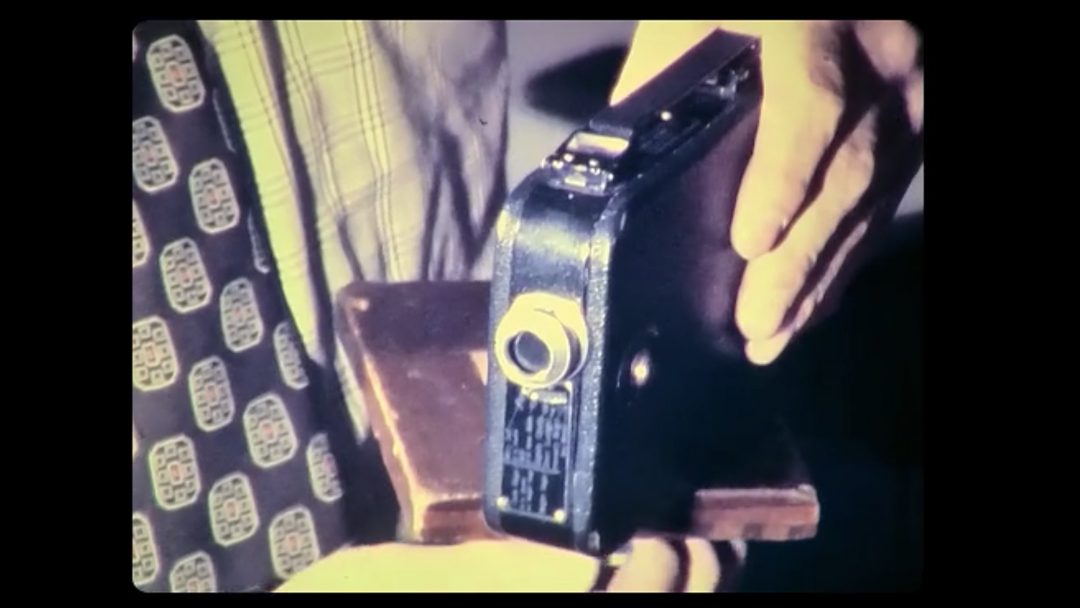
Footage Curated by Julian Bell

Pandemic: What do you remember from the day on which you found the film?

Julian: I don’t remember much about finding it at the charity store actually, but I do remember when I started to investigate what I had got. It was amongst a pile of other films, and it took a long time of course to view it all.

This particular family, from Amsterdam North, recorded films from 1962 to 1978. And it was all real home movies. But it was only when I started to project it and looked at what I had got that I started to realize that it was pretty good.

I’ve found quite a few old films, but there was a lot of people who didn’t know how to film – they take their cameras with them on holiday and they’re waving it about – zoom lenses were just invented so they’re zooming.

Pandemic: – Making you feel seasick.

Julian: Yeah. But back then there were the film clubs that people went to. This was a more social thing. It was in ’65 that super8 was invented – or brought to the market – and before that, it was old-fashioned 8mm, But in the ‘60s Kodak was trying to sell everything and so they were encouraging these film clubs and competitions (same as with photography) – it was all a big thing.

And at these film clubs, some people did learn how to film with a steady hand – and not make you feel seasick – and some people were really good. So I recognized this.

This film is from a box from this one family – there’s about 40 films I think.

One thing that you never see in the film is Father – he’s always behind the camera – which is a specialty of these films.

And the people in the film: I recognize one of the girls, she’s one of twins, but the other girl is not the other twin – she’s somebody else’s daughter. But then you’ve also got policemen in it – they’re filmed at the police bureau there; they’ve got a nun in there also – it’s all very social; when neighborhoods were much closer. I mean it was a whole different, nice thing in a way – out of the past.

Uit from Julian Bell on Vimeo.
Contributing Writers Creative Pieces FILTERED RECOLLECTIONS - October 2018

Distilled Into Fractions

Written by Nynke Nina


going over and over

keeping them sharp

keeping them vivid


every second

slowly fading

slowly less specific


the sound of your voice

the looks on your face

our interactions


sharing laughs

sharing thoughts

distilled into fractions


pieces of a reality

attempt of the mind

going back to events


and my thoughts wander and wander

making it a cracked mirror

to what it represents


the blueprint

of our experiences

is far away from me


reminiscing

but all I get

is a sample of reality


the connection we had

your sound

your face


reminiscing

but time

is blurring the trace


*You can find more of Nynke’s work at Mevalia.

 
Creative Pieces FILTERED RECOLLECTIONS - October 2018 Sybrand Veeger

To The Three Tuebingen Brothers

Written by Sybrand Veeger

Young philosophers and poets,

Romanticists and laureates:

Hegel, Holderlin, Schelling –

All boarded at the same dwelling.


Tuebingen: birthplace of this German school,

Housed the love for thought and God as World.

There the Spirit was wound up,

And charged up with philosophy’s jewel.


Before the romantic diamond was blasted

High into the Western firmament,

It was patiently polished by three friends,

Three brothers who looked through the same lens.


Our memory has been blurred somewhat,

By endless cynical tomes.

Let us do justice to this crazy lot

By listening to their polished tones:


Spirits and idealists,

Plaguing all their thought-lists,

Histories and dialectics,

Invading all our Geistes!


Hegel thought ideally,

Holderlin: poetically,

Schelling, the youngest madman:

Laughing stock of these boy-men.


Wisemen: human owls,

Obsessed with Grecian fouls,

“Philosophers of Nature”?

Transcendents of the Structure!


(Spinoza lived among them,

Both in thought and soul,

Forerunners of our Spirit,

– these Germans knew for sho!)


    -It’s Tuebingen! House of Genius!


Schelling und Zeit!

Was surely love at first sight:

– an expansive, contractive force,

Anti-hegelian with no remorse!

Schelling’s temporality,

Indeed lacked all possible linearity,

Question: Absolute Spirit?

Answer: No, Hegel, forget it!


Second boy, Hegel:

Napoleon, his World-Spirit,

No irony, his lyrics:

Too serious for satirists…


Third boy, Holderlin,

A true poet in his lyrics:

”Hyperion! The Greeks truly did it,

Philosophy, poetry, you name it!”


Holderlin willed no thought system;

He assigned verse to the Spirit’s voice:

“The poet’s vocation must be the combination

Of reason and energy, as musical expression”.


All these three combined,

Fused together are Divine:

They make up a human trinity

That deserves a space in memory:


Assign a corner of your soul

To this brotherhood’s legacy,

Hang a cross in your mind

As a reminder of their eternity.

Creative Pieces FILTERED RECOLLECTIONS - October 2018 Jonas Guigonnat

I Remember, Thus I Create

Written By Jonas Guigonnat

The ability of the human mind to be triggered by remembered sensations never stops astonishing me. Memory is often seen as a question of remembering “images” and “thoughts,” but all of our senses are playing a role. Most of the time it is a strong, subconscious activation.

Take the creative process as an example and you’ll realize how much past experiences are often the driver behind your capacity to create. Each sense plays a part, from what you heard, or tasted, to what you saw, or even touched.

Never underestimate the power of your memory. Even great temporal distance doesn’t seem to restrict the influence of the experiences and feelings we remember.

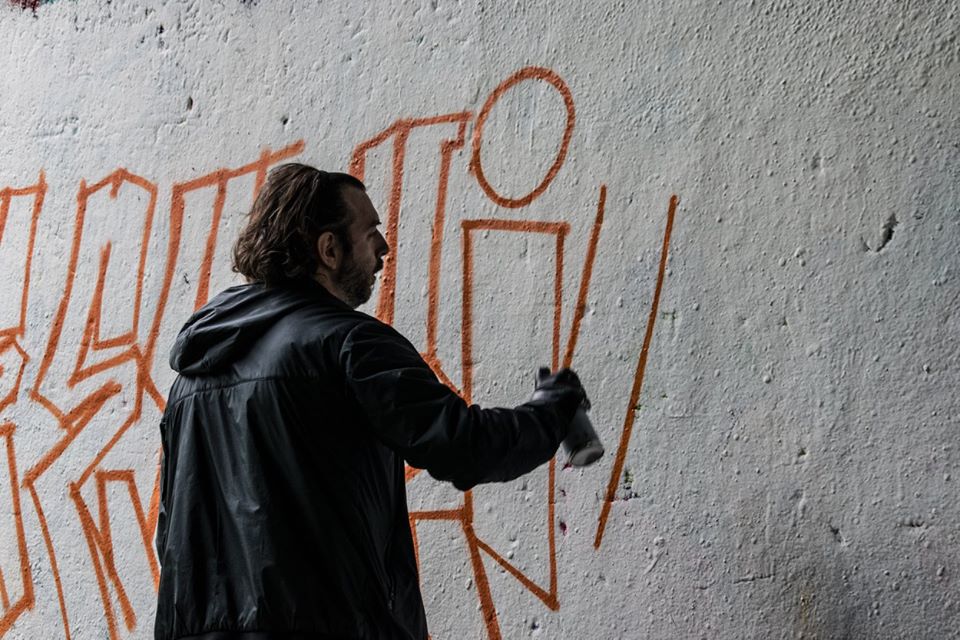
Twenty years ago I discovered graffiti and practiced it earnestly for about 5 years, but from that point onwards the feelings and sensations related to it never left my mind. As every graffiti artist, or “writer”, experiences it, my obsession for graffiti is never very far away, even when it feels like a lifetime ago.


Shapes of the streets

Everything began with what was to be seen: letters, letters, and again letters. They quickly became a source of obsession and modified the way I saw the creative process behind calligraphy. The style calligraffiti fascinated me at once, to the point I was dreaming of it.

I worked for hours trying to create shapes which transmitted the same energy, the same vibration as the pieces I saw on the streets. The feeling of being able to create my “own” letters motivated me to always do better. From that point onwards, every type of letter I saw could slip into my brain and find its way to the next piece of paper, and finally to the next wall.

Nowadays, even though I don’t practice actively, I still look for the perfect letters almost subconsciously. Any piece on the subway, on the street, or on the highway makes me want to take the cans and spray my letters out again.


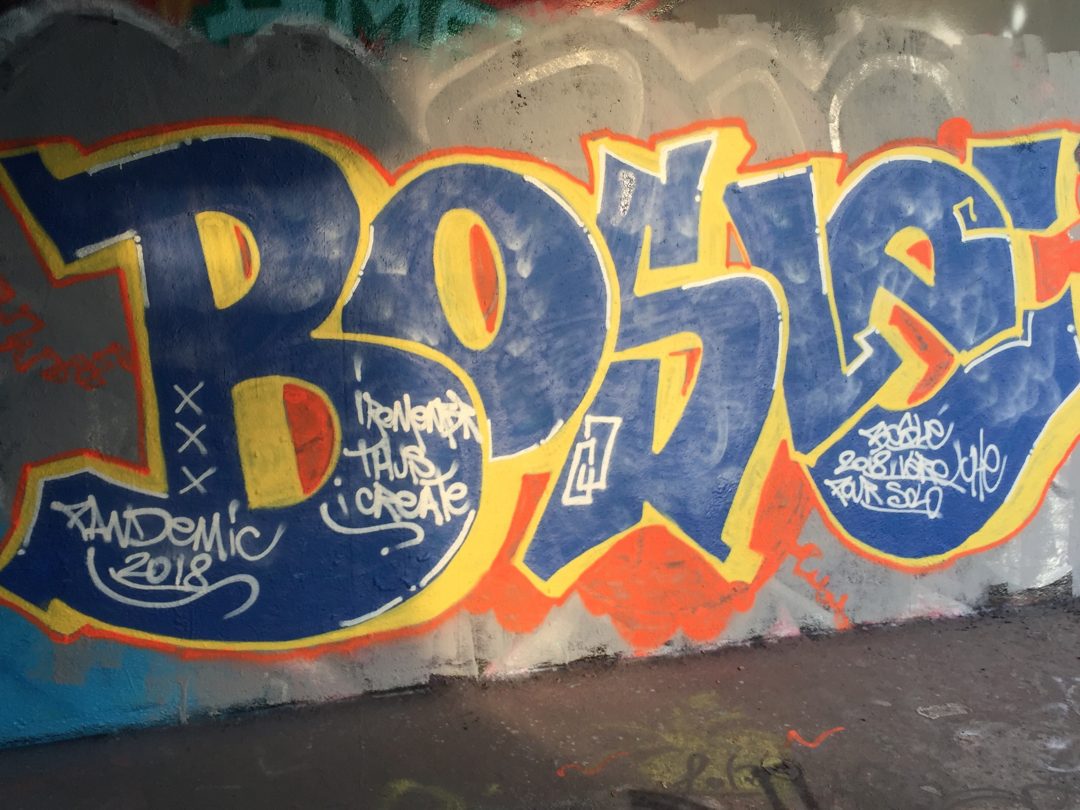
One of my pieces from April this year at a legal spot in Amsterdam. Photo: Jonas Guigonnat

Sounds of the past

My vision is thus playing a crucial part in this process, but my ears have also their part to play.

The noise of spraying cans still hooks me, the sound of pens scratching paper has never stopped haunting me, and the cacophony of Paris by night calls for me to paint its walls.

The sounds of every season bring me back to a place and time where I was writing something on the streets. Rain on scraps of steel, a subway taking its last ride, the silence of a sunny day or birds singing early in the morning – all of it triggers my will to create, even before my consciousness itself is aware of it.


Tell me what you smell, I’ll tell you what to create

Then there is also a multitude of triggering smells. Particularly the one of ink and of paint from a spray can, which awaken my obsession with the same force.

The same way noises play with my perception of the present, smells can also, out of nowhere, bring me back to a street in Paris in the early 2000s. The smell of wet leaves on a dark November day, of hot asphalt in the summer, or of a dry cold winter. All refer to moments of inspiration or of despair, either way pushing my creativity.

Touch and smell also have an influence, but it is a lot more subtle and difficult to grasp when it comes to the visual arts. Nonetheless, some feelings, like the one of grabbing a can, also push my mind to look for inspiration in the past.


One of my pieces from April this year at a legal spot in Amsterdam. Photo: Jonas Guigonnat

Holy adrenaline

When it comes to graffiti, if there is one bodily feeling above all others that I would choose, it is the adrenaline flowing through my body. Every writer experiences it as an addiction and as an important factor in this specific kind of creativity.

Taking risks is necessary if you want to exist in this environment. Otherwise, you would not be able to understand the essence of writing and will instead practice it like any other visual art.

But what makes graffiti unique in the eyes of thousands for almost 50 years (the discipline as such is said to exist since 1969) is mostly the fact that vandalism cannot be separated from the artistic process itself, once again, giving a feeling never to be forgotten.


One of my pieces from April this year at a legal spot in Amsterdam. Photo: Jonas Guigonnat

Creative network

The complex network of feelings recorded by my mind allows me to be creative in a very particular way. Not even my own will has as much influence on my capacity to express myself through art.

Without remembering what it feels like to create, there would be no creating, or at least not consistently. It also means that every time there is creation involved, the connections between the remembered sensations allows it to take form, to become real.

We exist through our memory as much as we create through it.